
01
Inventory information people can use
Turn technical classifications, incomplete records, and address-level uncertainty into a clear answer: what does the utility know about this property, what happens next, and where can a customer get help?
Sigler | Lead Service Line Inventory & Replacement Communications
National utility support
Lead service line work asks utilities to explain technical records, changing information, property access, construction, and public health in a way people can act on. Sigler helps water utilities and engineering partners build the communications system around that work—nationally, without a one-size-fits-all script.
The communication challenge
A resident is not reading an inventory as a data exercise. They are asking whether their home is affected, whether they need to grant access, what replacement will mean for their property, and whether the utility is being direct. Useful public information answers those questions before they become a call-center queue, elected-official inquiry, or neighborhood rumor.
01
Turn technical classifications, incomplete records, and address-level uncertainty into a clear answer: what does the utility know about this property, what happens next, and where can a customer get help?
02
Prepare owners, renters, landlords, property managers, and customer-service teams for verification, scheduling, work-day impacts, restoration, and the questions that can otherwise slow the program.
03
Connect the work in neighborhoods to a credible public-health purpose, a visible program plan, and a dependable update rhythm—without overstating what testing or records can establish.
Make complex inventory and replacement requirements clear, credible, and actionable for the customers your utility serves.
Communications scope
EPA guidance recognizes that service-line inventory work includes communicating information to the public. The most effective programs treat that responsibility as an operating system—linking engineering inputs, regulatory coordination, customer communication, field activity, and feedback into one usable experience.
Read EPA inventory guidance →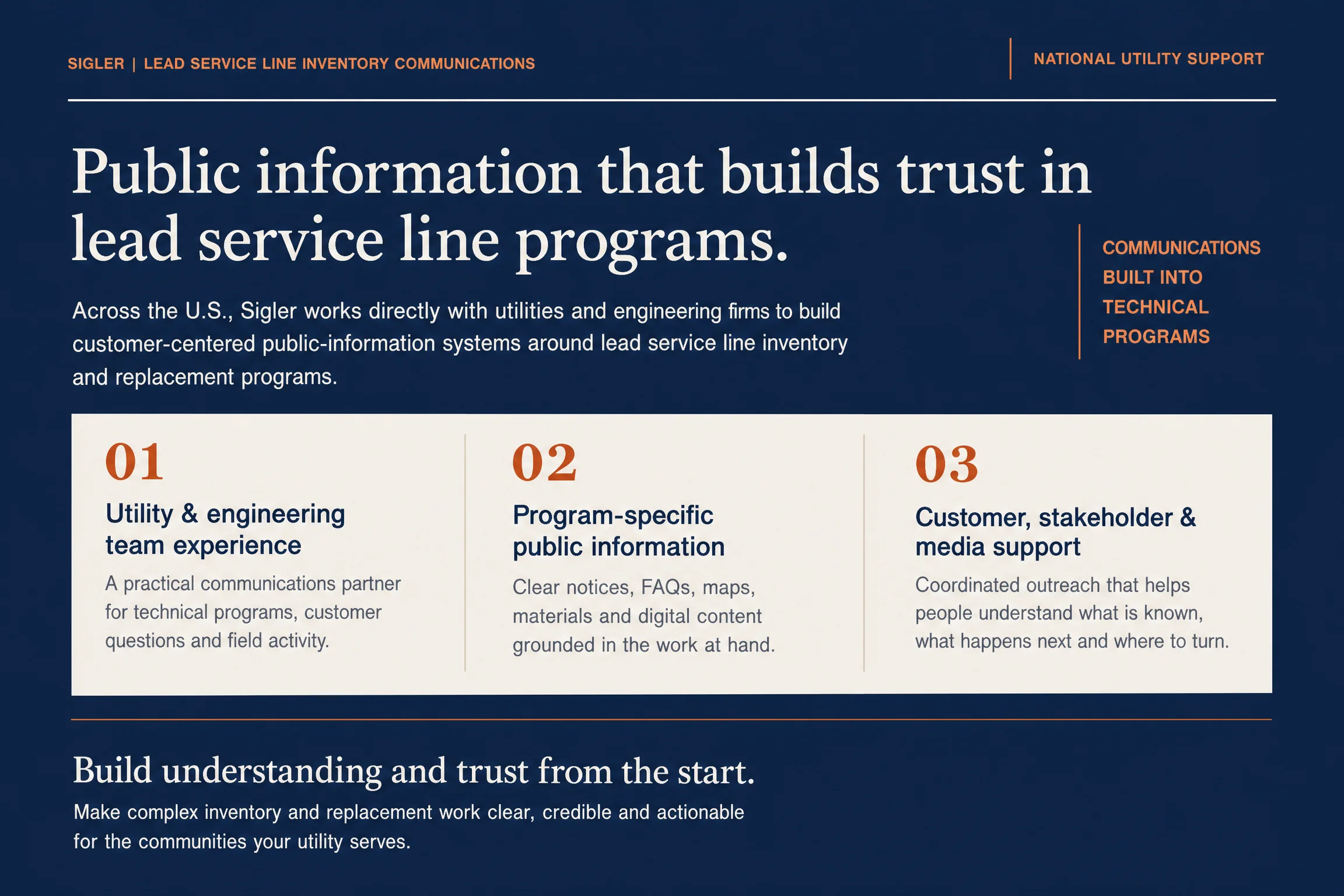
Where Sigler fits
Before launch
Establish plain-language terminology, approval paths, a customer-question log, staff scripts, translation and accessibility needs, and the information that must be available before a public inventory goes live.
Inventory and verification
Coordinate maps, mailed notices, digital content, community outreach, and customer-service responses so the public understands both what the record shows and how the utility will verify an unknown material.
Replacement planning
Create the sequence for notices, scheduling, access, fieldwork, temporary disruption, restoration, and post-work follow-up before crews begin contacting residents.
Program delivery
Support neighborhood-specific notifications, elected-official briefings, partner outreach, progress reporting, media response, and issue escalation as replacement work moves through the service area.
Verified utility proof
Sigler led communications for the City of Greeley’s lead service line inspection and replacement program, including campaign strategy, customer survey guidance, messaging, fact sheets, FAQs, maps, infographics, news releases, and website content. That experience informs a practical approach to translating technical program inputs into public information people can use.
Meet Janet Rummel and view relevant program experience →With engineering and utility teams
Translate technical findings without losing the precision that operations, regulators, and legal advisors need.
With customers and communities
Create an address-specific path for questions about records, access, scheduling, impact, responsibility, and follow-up.
With stakeholders
Give elected officials, community partners, property managers, call-center teams, and field staff a consistent way to share accurate information.
Frequently asked questions
It should explain why the customer is receiving the information, what the utility can confirm about the service line at that address, what remains unknown if records are incomplete, whether any action is needed now, and how to get a property-specific answer. The goal is clarity—not a technical data dump.
Say plainly that the record is incomplete, describe the verification path, and avoid presenting an unknown classification as either an emergency or a nonissue. Customers need to understand the next step, how long it may take, and where the utility will post updates when the classification changes.
Before the first public inventory release or field appointment. Customer-service staff, property owners, local officials, community partners, and contractors should have a shared set of answers before the utility asks residents for access or action.
The technical team determines the engineering work and program requirements. Sigler helps translate those inputs into an organized communications system: customer notices, FAQs, maps and visual tools, field and call-center scripts, stakeholder materials, public outreach, and a response process for recurring questions.
Continue the work
Customer journey guide
A practical guide to address-specific notices, property access, and the questions behind customer questions.
Water expertise
Explore Sigler’s experience from permitting and construction through water-quality response and public education.
Service path
Build a coordinated approach for community partners, local leaders, property stakeholders, and the people who need usable answers.
Service path
Coordinate the public information, leadership briefings, and stakeholder strategy that keeps a complex program credible as it moves forward.
Water-quality readiness
See the incident-timeline framework for moments when water-quality questions move faster than routine program communications.
Lead service line communications
Whether you are preparing an inventory, refining a replacement plan, or coordinating with a technical partner, Sigler can help create public information that earns confidence before the next customer notice goes out.
Discuss Lead Service Line Communications →Ready to start a conversation?
Contact Us